Table Of Contents
- Understanding IF-THEN Logic: The Foundation of Adaptive Learning
- How IF-THEN Logic Enables Personalization at Scale
- Real-World Applications Across Industries
- Building Effective IF-THEN Learning Paths
- The No-Code Revolution in Adaptive Learning
- Implementation Strategies for Maximum Impact
- Measuring Success and Optimization
Imagine a personal tutor who knows exactly what each student needs, adapting instantly to their learning pace, style, and comprehension level. Now imagine that tutor working with thousands of learners simultaneously, providing individualized guidance to each one. This isn’t science fiction—it’s the power of IF-THEN logic in modern learning systems.
IF-THEN logic, also called conditional logic or branching logic, forms the backbone of adaptive learning experiences that scale effortlessly. At its core, it’s beautifully simple: IF a learner demonstrates a specific behavior or provides a particular response, THEN the system delivers tailored content, feedback, or next steps designed specifically for that situation. This fundamental programming concept has transformed from a technical requirement into an accessible tool that educators, trainers, and content creators can harness without writing a single line of code.
The challenge facing modern education and training isn’t just creating quality content. It’s delivering the right content to the right person at the right time, while serving dozens, hundreds, or thousands of learners with diverse backgrounds, goals, and learning needs. Traditional one-size-fits-all approaches leave fast learners bored and struggling learners overwhelmed. IF-THEN logic solves this by creating intelligent pathways that respond dynamically to each individual’s journey through your content.
In this comprehensive guide, we’ll explore how IF-THEN logic powers personalized learning at scale, examine real-world applications across industries, and discover how modern platforms are making this technology accessible to everyone, regardless of technical expertise. Whether you’re an educator designing coursework, a business owner creating training programs, or a content creator building interactive experiences, understanding IF-THEN logic will transform how you approach learning design.
IF-THEN Logic: Personalized Learning at Scale
The Complete Visual Guide
What is IF-THEN Logic?
Simple conditional logic that creates intelligent, adaptive learning pathways:
IF learner demonstrates behavior
THEN system delivers tailored content
1:1000+
One tutor serving thousands of learners simultaneously
Analyze
System tracks learner responses and behaviors
Decide
Conditional logic determines optimal pathway
Adapt
Delivers personalized content and feedback
Real-World Applications Across Industries
Education & Training
Differentiated learning, adaptive assessments, compliance training, and skill-based routing
Healthcare & Wellness
Medical training simulations, patient education, personalized health guidance, and therapeutic support
Customer Support
Intelligent chatbots, contextual help systems, and personalized product onboarding experiences
The No-Code Revolution
5-10
Minutes to build
0
Coding required
∞
Scalability
Visual drag-drop-link interfaces put sophisticated IF-THEN logic in everyone’s hands
5 Keys to Building Effective Learning Paths
Define clear conditions: Use specific, measurable criteria for triggers
Create meaningful alternatives: Each pathway offers genuine value
Avoid excessive branching: Start simple, add complexity strategically
Plan for edge cases: Always include default pathways
Test all pathways: Verify every branch delivers value
Ready to Build Adaptive Learning?
Create personalized AI-powered applications with IF-THEN logic—no coding required
Understanding IF-THEN Logic: The Foundation of Adaptive Learning
IF-THEN logic operates on a simple premise that mirrors how we naturally make decisions every day. When you check the weather and decide whether to bring an umbrella, you’re using IF-THEN logic: IF it’s going to rain, THEN I’ll bring an umbrella. In learning systems, this same logical structure creates intelligent responses to learner behavior, building experiences that feel personalized and responsive.
In educational contexts, IF-THEN statements create conditional pathways based on learner actions, responses, or performance metrics. For example, IF a student answers a quiz question correctly, THEN they progress to more advanced material. IF they answer incorrectly, THEN they receive additional explanation and practice exercises on that concept. This branching creates a dynamic learning experience where the content adapts to each individual’s demonstrated knowledge and needs.
The power of IF-THEN logic extends beyond simple right-or-wrong scenarios. Modern adaptive learning systems use multiple conditions and nested logic to create sophisticated decision trees. You might structure logic that says: IF a learner completes Module 1 with a score above 80% AND indicates they have prior experience in the topic, THEN skip the review material and advance to intermediate content. ELSE IF they score between 60-80%, THEN provide optional supplementary resources before moving forward. This layered approach ensures that learners receive exactly the level of support they need.
What makes IF-THEN logic particularly valuable for learning is its ability to accommodate multiple learning styles and paces simultaneously. A traditional classroom or linear online course moves at a fixed pace, leaving some learners behind while holding others back. IF-THEN logic creates parallel pathways through the same material, allowing each person to travel at their optimal speed and receive content formatted for their preferences. One learner might receive video explanations while another gets text-based content, all determined by their indicated preferences or demonstrated engagement patterns.
How IF-THEN Logic Enables Personalization at Scale
The phrase “personalization at scale” sounds contradictory. After all, personalization traditionally requires individual attention, which seems impossible to scale. IF-THEN logic resolves this paradox by automating the decision-making process that creates personalized experiences. Once you’ve built the conditional pathways, the system can serve thousands of learners simultaneously, each receiving an experience tailored to their specific needs, performance, and preferences.
Consider a corporate training program with 500 employees at varying skill levels. Without adaptive logic, you’d need to create separate courses for beginners, intermediate learners, and advanced professionals, then manually assign people to the appropriate track. With IF-THEN logic, you create one intelligent program that automatically routes each employee through the appropriate content based on their assessment results, role requirements, and learning progress. The system makes hundreds of micro-decisions for each learner, creating a unique pathway while requiring no additional instructor time or intervention.
The scalability comes from the reusability of logic patterns. When you design an IF-THEN pathway that works effectively for one learner scenario, that same logic applies to every future learner who encounters similar conditions. You might invest time upfront mapping out ten different learning pathways based on common scenarios, but once built, those pathways serve unlimited learners without additional effort. The system never gets tired, never forgets the logic, and applies it consistently to every interaction.
This scalability extends beyond content delivery to feedback and assessment. Traditional grading requires instructors to review each submission individually, providing personalized feedback based on what they observe. IF-THEN logic can automate much of this process by defining responses to anticipated answers or behaviors. IF a learner submits an essay that includes specific keywords or concepts, THEN provide feedback acknowledging those strengths while prompting deeper exploration of related ideas. IF key concepts are missing, THEN suggest specific resources that address those gaps. While this doesn’t replace all human feedback, it provides immediate, relevant guidance to learners at a scale no human instructor could match.
Real-World Applications Across Industries
IF-THEN logic’s versatility makes it valuable across virtually every industry that deals with knowledge transfer, skill development, or behavior change. The fundamental principle remains the same, but applications vary dramatically based on specific needs and contexts. Let’s explore how different sectors leverage this technology to solve unique challenges.
Education and Corporate Training
Educational institutions use IF-THEN logic to create differentiated learning experiences that accommodate diverse student populations. A mathematics program might use conditional logic to identify when students struggle with a particular concept, automatically providing additional practice problems, alternative explanations using different teaching methods, or even video tutorials from different instructors. IF a student masters concepts quickly, THEN the system presents enrichment activities and advanced challenges rather than redundant practice.
Corporate training programs leverage IF-THEN logic to make onboarding and professional development more efficient. New employee orientation systems can branch based on role, department, location, and prior experience. A sales representative with ten years of industry experience receives different onboarding content than a recent college graduate, even though both are joining the same company in similar roles. The system recognizes these differences through initial assessments or profile data and routes each person through appropriate pathways.
Compliance training, often the most dreaded type of corporate learning, becomes more bearable with adaptive logic. Instead of forcing everyone through identical content regardless of their familiarity with regulations, IF-THEN systems can assess existing knowledge and exempt learners from reviewing material they’ve already mastered. Those who demonstrate understanding through pre-assessments receive abbreviated certification paths, while those needing more support get comprehensive instruction. This respect for learners’ time increases engagement and completion rates.
Healthcare and Wellness
Healthcare education and patient support represent critical applications where personalization directly impacts outcomes. Medical training simulations use IF-THEN logic to create realistic scenarios that branch based on the decisions trainees make. IF a medical student selects one diagnostic test, THEN they receive specific results that inform their next decision. IF they choose a different test, THEN the scenario unfolds differently, teaching through consequences without risking actual patient safety.
Patient education platforms use conditional logic to deliver health information appropriate to each person’s condition, literacy level, and learning preferences. A diabetes management app might provide different guidance based on whether someone has Type 1 or Type 2 diabetes, their current medication regimen, dietary restrictions, and blood sugar patterns. The system adapts recommendations in real-time as patients log data, creating a responsive support system that feels personally relevant rather than generic.
Mental health and wellness applications employ IF-THEN logic to guide users through therapeutic exercises and coping strategies. Mood tracking apps can recommend specific interventions based on reported feelings and patterns. IF a user reports feeling anxious three days in a row, THEN the app might suggest particular breathing exercises, cognitive reframing techniques, or prompts to connect with support resources. These conditional responses provide timely support scaled across thousands of users simultaneously.
Customer Support and Onboarding
Customer service chatbots and virtual assistants rely heavily on IF-THEN logic to provide relevant help without human intervention. When a customer asks a question, the system analyzes keywords and context to determine intent, then delivers appropriate responses or guides them through troubleshooting steps. IF a customer mentions a billing issue, THEN route to account management resources. IF they’re asking about product features, THEN provide specifications and tutorials. This conditional routing resolves many inquiries instantly while escalating complex issues to human agents.
Product onboarding experiences use IF-THEN logic to help new users get value quickly based on their specific use case. A project management software might ask new users about their role and team size, then customize the onboarding walkthrough accordingly. IF someone manages a remote team, THEN highlight communication and collaboration features. IF they’re a solo freelancer, THEN focus on personal productivity and client management tools. This targeted approach prevents information overload and accelerates time-to-value.
Building Effective IF-THEN Learning Paths
Creating effective adaptive learning experiences requires thoughtful planning beyond simply understanding the technical concept of IF-THEN logic. The most successful implementations start with learner needs and work backward to the logic that serves them. Before building any conditional pathways, ask yourself what learner scenarios you’re trying to address and what different experiences would best serve those situations.
Begin by mapping your learner personas and the likely paths they’ll take through your content. Identify decision points where learners might benefit from different experiences based on their responses, performance, or preferences. Not every interaction needs branching logic. Focus on high-impact moments where personalization truly enhances the learning experience, such as after assessments, when introducing complex concepts, or when learners indicate confusion or difficulty.
Key considerations when building IF-THEN learning paths include:
- Define clear conditions: Be specific about what triggers each pathway. Vague conditions lead to unpredictable experiences. Instead of “IF learner struggles,” define measurable criteria like “IF learner scores below 70% on the module quiz.”
- Create meaningful alternatives: Each pathway should offer genuine value, not just slightly different wording of the same content. Alternative paths might include different media formats, varying difficulty levels, additional context, or entirely different teaching approaches.
- Avoid excessive branching: While complex decision trees are possible, they become difficult to manage and test. Start with simple binary choices and add complexity only where it demonstrably improves outcomes.
- Plan for edge cases: What happens if a learner’s response doesn’t match any of your anticipated conditions? Always include default pathways that ensure learners can progress even in unexpected scenarios.
- Test all pathways: Unlike linear content where testing means following one path, adaptive content requires testing every possible branch to ensure learners receive coherent, valuable experiences regardless of which route they take.
Documentation becomes crucial when working with IF-THEN logic, especially in team environments. Create flowcharts or decision trees that visually map how learners move through your content based on different conditions. This documentation helps team members understand the logic, makes it easier to identify gaps or redundancies, and simplifies future updates. What seems perfectly clear when you’re building the logic may become confusing months later when you need to make changes.
The No-Code Revolution in Adaptive Learning
Historically, implementing IF-THEN logic in learning systems required programming skills or expensive custom development. Instructional designers would sketch out the desired branching logic, then rely on developers to build it, creating a translation gap where educational intent sometimes got lost in technical implementation. This barrier kept adaptive learning largely confined to well-funded institutions and corporations with substantial technology budgets.
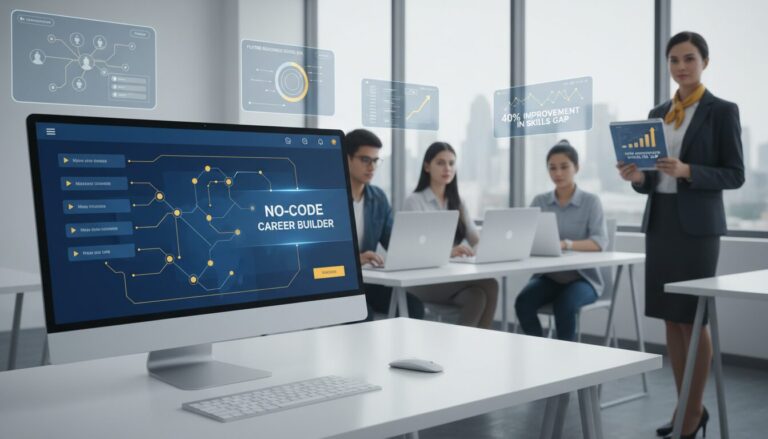
The emergence of no-code platforms has democratized adaptive learning, putting powerful IF-THEN logic in the hands of educators, trainers, and content creators without any programming background. Visual interfaces let users build conditional pathways by dragging, dropping, and connecting elements in intuitive ways that mirror how they think about learning design. Instead of writing code that says “if score < 70 then redirect to review_module," users simply connect quiz results to different content blocks based on score ranges.
Platforms like Estha exemplify this transformation by enabling anyone to create sophisticated AI-powered learning applications in minutes rather than months. The drag-drop-link interface abstracts away technical complexity while preserving the full power of conditional logic. An educator can build an adaptive quiz that provides personalized feedback, branches to different content based on responses, and adjusts difficulty dynamically, all without understanding the underlying code that makes it work.
This accessibility shift has profound implications for learning design. When creators can experiment with adaptive logic themselves, they iterate faster and create better experiences. They don’t need to perfectly specify requirements upfront for a developer, then wait weeks to test if their ideas work. Instead, they build a prototype, test it with real learners, observe how the logic performs, and refine it immediately based on what they learn. This rapid iteration cycle produces better learning outcomes and more engaging experiences.
No-code platforms also lower the barrier for sharing and monetizing educational expertise. Subject matter experts who previously couldn’t translate their knowledge into interactive digital experiences can now create AI-powered learning applications that embed their expertise in conditional logic. A language teacher can build an adaptive conversation practice tool, a fitness professional can create personalized workout guidance systems, or a business consultant can develop interactive assessment and advice tools, all without hiring developers or learning to code.
Implementation Strategies for Maximum Impact
Successfully implementing IF-THEN logic in learning experiences requires strategic thinking about where adaptive pathways add the most value. Not every learning interaction benefits from branching logic, and over-complicating simple content with unnecessary conditions can actually degrade the user experience. The goal isn’t to make everything adaptive, but to strategically apply conditional logic where it meaningfully improves learning outcomes or efficiency.
Start small with high-impact scenarios rather than attempting to make your entire learning program adaptive from day one. Identify pain points in your current learning experience where personalization would make a significant difference. Common high-value scenarios include post-assessment pathways (routing learners to review or advancement based on performance), prerequisite knowledge checks (letting experienced learners skip foundational material), and learning preference accommodation (offering content in multiple formats based on user selection).
Layer your adaptive logic progressively as you gather data about how learners interact with your content. Initial implementations might use simple binary conditions: pass/fail assessments, yes/no preference questions, or beginner/advanced skill level selections. As you observe learner behavior and outcomes, add more sophisticated conditions that respond to patterns you notice. Perhaps learners who take breaks longer than 10 minutes when studying a particular concept need a different instructional approach, or those who consistently choose video content learn better when visual information includes specific types of annotations.
Best practices for implementing adaptive learning logic:
- Establish baseline metrics: Before implementing adaptive logic, measure current learning outcomes with your linear content. This gives you comparison data to assess whether personalization actually improves results.
- Design for transparency: Let learners understand why they’re receiving specific content or following particular pathways. Transparency builds trust and helps learners feel the personalization is serving them rather than manipulating their experience.
- Provide override options when appropriate: Sometimes the logic will guess wrong about what a learner needs. Giving users the ability to access alternative pathways or skip sections they find unnecessary respects their autonomy and prevents frustration.
- Balance automation with human touchpoints: IF-THEN logic handles routine personalization efficiently, but complex learning challenges often benefit from human expertise. Design systems where automated pathways handle common scenarios but escalate unusual situations or persistent struggles to instructors or mentors.
- Continuously refine based on data: Adaptive learning systems generate rich data about which pathways learners follow, where they struggle, and what interventions prove effective. Use this information to continuously improve your conditional logic, adding new pathways for scenarios you didn’t initially anticipate.
Measuring Success and Optimization
The effectiveness of IF-THEN logic in learning systems isn’t just theoretical; it should produce measurable improvements in learner outcomes, engagement, and efficiency. Establishing clear metrics before implementation helps you assess whether your adaptive pathways deliver the value you intended and where refinement might be needed. Unlike linear learning experiences where success metrics are relatively straightforward, adaptive systems require more nuanced measurement approaches that account for different learner pathways.
Completion rates often improve with adaptive learning because personalization reduces frustration and boredom, two primary reasons learners abandon courses. Track not just overall completion but pathway-specific completion to identify whether certain branches are more effective than others. If learners routed to remedial content show significantly lower completion than those on advanced tracks, your remedial pathway might need redesign to be more engaging or efficient. The goal is ensuring every pathway you create supports learners effectively toward completion.
Learning outcomes represent the ultimate success metric for educational applications. Compare assessment performance between adaptive and non-adaptive versions of your content, or between different adaptive pathways if you’re A/B testing approaches. Look beyond simple pass/fail rates to examine knowledge retention over time, ability to apply concepts in new contexts, and skill transfer to real-world situations. The best adaptive logic doesn’t just help learners pass tests; it builds deeper, more durable understanding by meeting them at their current level and guiding them forward strategically.
Efficiency metrics matter particularly in corporate training and professional development contexts where time investment carries direct costs. IF-THEN logic should help learners reach competency faster by eliminating redundant content for experienced learners while providing additional support to those who need it. Measure time-to-competency across different learner segments and pathways. If your adaptive system lets advanced learners test out of foundational material and reach certification 40% faster while helping struggling learners ultimately achieve the same competency with additional support, that represents significant value creation.
User satisfaction and engagement metrics provide insight into the qualitative experience of your adaptive system. Survey learners about whether they felt the content was appropriately paced for their level, whether they appreciated receiving personalized pathways, and whether they would recommend the experience to others. Track engagement signals like session duration, voluntary exploration of optional content, and return visits. High-performing adaptive systems feel responsive and respectful of learners’ time and existing knowledge, which manifests in positive sentiment and behavior.
Analytics from your adaptive pathways reveal opportunities for optimization. Which conditional branches do most learners follow? Are there pathways you created that almost no one ever encounters, suggesting your conditions might be too narrow or the scenario too rare to justify the maintenance effort? Conversely, are there common learner scenarios that don’t have dedicated pathways yet, where adding conditional logic could improve experiences? Let your actual usage data guide ongoing refinement of your IF-THEN logic rather than relying solely on initial assumptions about what learners need.
IF-THEN logic transforms learning from a one-size-fits-all broadcast into a personalized conversation scaled across unlimited learners. By establishing conditional pathways that respond intelligently to individual behaviors, responses, and needs, educators and trainers create experiences that feel custom-built for each person while requiring no additional effort as audiences grow. The fundamental simplicity of “if this, then that” belies the sophisticated, responsive learning ecosystems it enables.
The democratization of this technology through no-code platforms represents a pivotal shift in who can create adaptive learning experiences. What once required development teams and substantial budgets now sits within reach of any educator, trainer, or content creator with expertise to share and learners to serve. This accessibility unleashes innovation from practitioners closest to learners’ needs, the people who understand what personalization would most benefit their specific audiences.
As you consider implementing IF-THEN logic in your learning design, remember that the technology serves the pedagogy, not the reverse. Start with clear understanding of your learners’ diverse needs, then build conditional pathways that address those needs strategically. Test, measure, refine, and expand your adaptive logic based on real outcomes and feedback. The most successful implementations balance sophisticated personalization with simplicity, creating experiences that feel effortlessly tailored without overwhelming learners or creators with unnecessary complexity.
The future of learning is undeniably personal, and IF-THEN logic provides the foundation for delivering that personalization at any scale. Whether you’re teaching five students or five thousand, the same thoughtfully designed conditional pathways can guide each person through a journey optimized for their success.
Ready to Build Adaptive Learning Experiences?
Create personalized AI-powered learning applications with IF-THEN logic in minutes, not months. No coding required.